
Antigua and Barbuda’s citizenship contribution, from the family bill to passport renewal
A contribution of USD 230,000 to Antigua and Barbuda’s National Development Fund can support an individual or family application for citizenship. The number and ages of the people applying, and whether anyone else supplies the money, affect what the family pays beyond that contribution. The first programme passport is valid for 5 years. Evidence of time spent in the country matters at renewal. On 12 November 2026, the Citizenship by Investment Unit confirmed that it was still accepting applications.[1][2][3][13]
In this article
- Life in St John’s and Codrington
- Where the National Development Fund spends the money
- Which relatives qualify
- The amounts due at filing and after approval
- The agent’s role and the checks on each applicant
- Travel records for the first passport renewal
- Applications remain open while transition terms are discussed
- Sources
Life in St John’s and Codrington
About 50 kilometres north of Antigua, where St John’s serves as the national capital and commercial port, lies Barbuda. Most Barbudans live in Codrington, close to the lagoon and the fishing grounds offshore. The territory also includes smaller islands such as uninhabited Redonda. The UN estimated the country’s population at about 94,000 in 2025. A family considering a home in Barbuda will need a different plan for schools, medical appointments and transport from one based near the capital.[18][19][20]
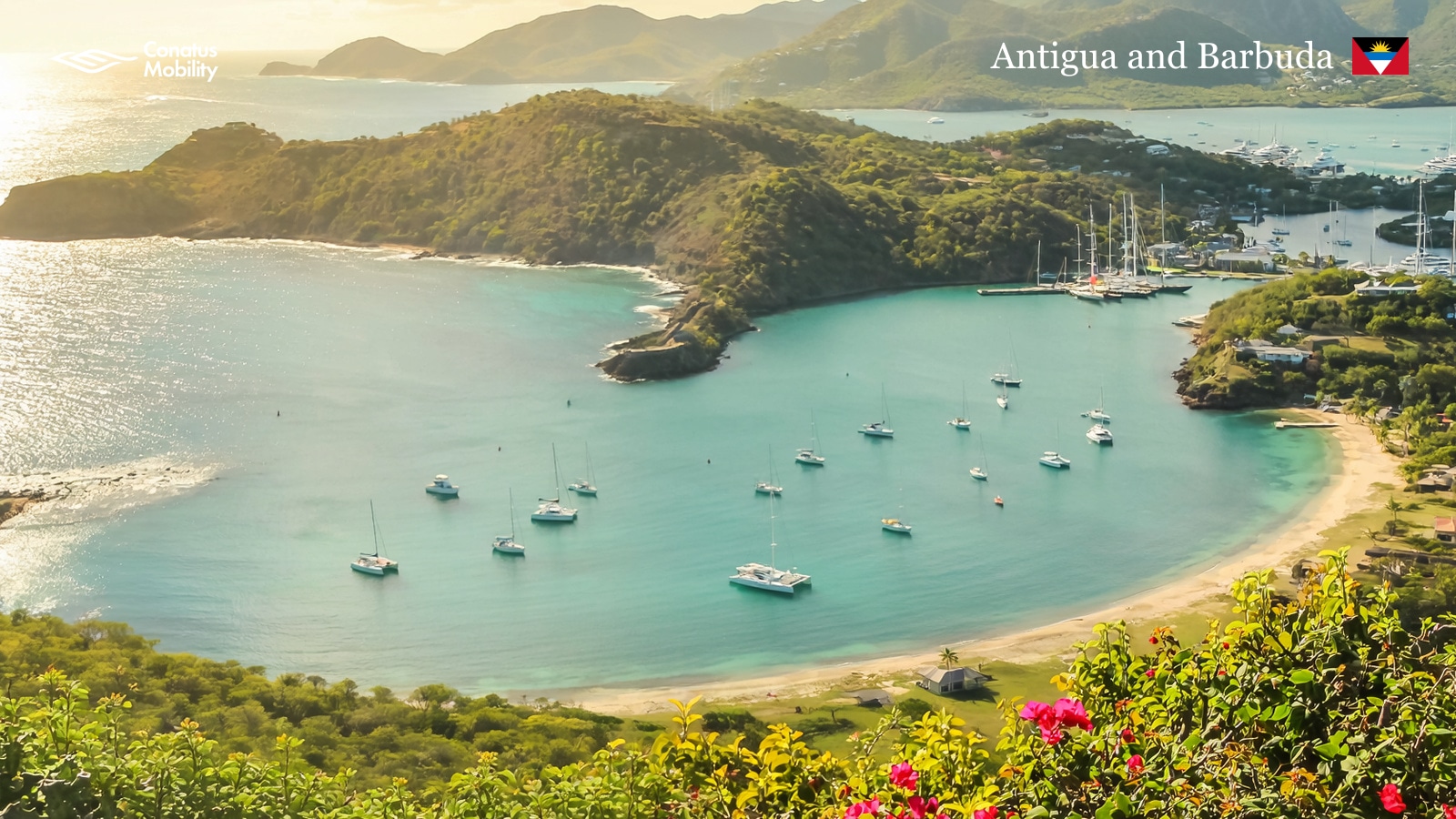
At English Harbour on Antigua’s south coast, a sheltered inlet offered the British navy a place to repair ships in the 18th century. Generations of enslaved Africans built the dockyard that survives today. The islands played different parts in the colonial economy. Sugar plantations dominated Antigua. The Codrington family leased Barbuda and supplied neighbouring estates with timber and livestock. Since independence on 1 November 1981, Barbuda has retained its own council for local affairs. Citizenship is a national responsibility.[18][20][21]
English is the language of administration, and the Eastern Caribbean dollar (XCD) is the local currency. Tourism, yachting, cruise traffic and construction generate employment and public revenue, while adding demand for water, electricity and roads. Education also draws on regional institutions. The University of the West Indies opened its Five Islands Campus in Antigua in 2019 to serve students across the Eastern Caribbean. The university sets its own admissions and fees. A contribution to the National Development Fund does not reserve a place for a child.[1][18][19][22][23]
Where the National Development Fund spends the money
School breakfasts at Glanvilles Primary School appear in the Unit’s report for the first half of 2024. An entry dated 12 March names the school and the purpose of the payment. Other entries concern hospital air-conditioning, refuse vehicles and cricket facilities. These accounts show what the programme has supported. They give contributors neither authority to earmark their payment for a particular school nor a title to any asset financed through the fund.[1][9]
Section 42(2) of the Finance Administration Act 2006 established the National Development Fund (NDF). It can support government-sponsored projects, public-private partnerships and approved charitable expenditure, and must report to Parliament every 6 months. Once paid following approval, the contribution is non-refundable. A family that expects to need the capital later for education, care or retirement must provide for that expense elsewhere. The fund offers no redemption date or share of project income.[1][7][9]
There is a budgetary step between a family’s contribution and a beneficiary’s expenditure. A disbursement date in the half-yearly report records a public payment to the named recipient. For a compliance declaration about its own transfer, the family should use its approval letter, the actual payment date, beneficiary and purpose. A school’s receipt or a project announcement documents public use. It cannot establish who funded a particular overseas transfer, when it cleared or whether it satisfied the full amount due.[1][9]
The 2024 accounts still record contributions of USD 100,000, and payments of USD 125,000 by some families of 5. The old concession expired at 23:59 on 31 July 2024. Amendment Regulations No. 50 of 2024 set the minimum at USD 230,000 for an individual or a family. The older accounts remain a record of public spending. Using their historical rates to budget for a new application would understate the contribution by more than USD 100,000.[4][9]
Which relatives qualify
Each relative needs evidence of the relationship under which they apply. A marriage record links spouses. A birth or adoption record links parent and child. Where the spouse’s mother is joining the family, the chain may include the couple’s marriage record, the spouse’s birth record and documents explaining any subsequent change of surname. Births, marriages and divorces often take place in different jurisdictions. The file should account for different spellings or names used for the same person in their civil records.[4][5][11]
The ordinary child category extends to age 30 inclusive, and the Unit requires financial dependence. For an adult child who has left education, an old student card says little about who pays the rent today. Separate provisions cover adult children who cannot support themselves because of a physical or mental impairment and are fully maintained by the applicant. Parents and grandparents must also meet dependency conditions. The Unit’s dependants page uses age 55 or over, while other official wording differs at the boundary. A licensed agent should obtain a case-specific written answer for someone aged exactly 55.[1][4][5]
The regulations also recognise unmarried siblings, with parental or guardian consent where the sibling is under 18. A dependant who later marries or has a child may be able to add family members under separate provisions governing relationships, age and fees. Published processing fees for additions are USD 10,000 for a child aged 0–5, USD 25,000 at 6–17 and USD 50,000 for an adult dependant. Applicable checks and passport fees are extra. Qualifying for a family rate on the initial application does not secure that rate for a later addition.[2][4][5]
Where a registered dependent child later marries or becomes a parent, that child’s own age can also matter. The amended regulations specify an age boundary of 35 for the relevant addition. The original file establishes the dependant’s position at the time. A later application for their spouse or child is assessed against the relationship and age conditions then in force. The original family declaration, registration certificate, marriage record and birth record establish when each relationship arose.[2][4]
A family may nominate an alternate principal applicant at filing. The nominee must already be included in the case and be at least 18. The provision operates if the principal applicant dies or becomes physically or mentally incapacitated. For couples who own assets together, the nomination and the authority to operate a bank account address different matters. A spouse able to continue the citizenship application may still need separate authority to instruct the bank.[4]
The amounts due at filing and after approval
Consider a principal applicant filing with a spouse and children aged 9 and 14, all applying for the first time with the couple’s own funds. The contribution is USD 230,000 and processing costs USD 20,000. Due diligence costs USD 8,500 for the principal applicant, USD 5,000 for the spouse and USD 2,000 for the 14-year-old. None is charged for the 9-year-old. Add USD 300 per passport and USD 1,500 for the family interview. These published items total USD 268,200, before professional fees, translations, document certification, banking or travel.[1][2][6]
At filing, the family pays 10% of the processing fee, or USD 2,000, plus USD 15,500 for due diligence and USD 1,500 for the interview, a total of USD 19,000. The initial processing payment and due diligence fees are non-refundable. After approval, the remaining processing fee is USD 18,000, the passports cost USD 1,200 and the fund receives USD 230,000, bringing the balance to USD 249,200. The contribution is due within 30 days of the approval instructions. A deposit maturity or property sale may have its own timetable.[1][2][6]
A single applicant cannot divide the family quotation by the household headcount. The contribution remains USD 230,000, with USD 10,000 in processing, USD 8,500 for due diligence, USD 1,500 for interview and USD 300 for the passport. On the same basis the subtotal is USD 250,300, of which USD 11,000 is due at filing and USD 239,300 after approval. This illustration assumes a self-funded individual and no additional checks. It does not cover the subsequent addition of relatives.[1][2][6]
If a dependent grandmother aged 60 also qualifies and joins, the contribution remains USD 230,000. The extra member adds USD 10,000 in processing, USD 4,000 for due diligence and USD 300 for her passport. The subtotal becomes USD 282,500. A relative who only supplies the money falls under a different provision: the fee schedule lists USD 5,000 for due diligence on a benefactor. A quote needs to identify both the applicants and the source of the money, especially where different people fill those roles.[2][5][6]
The agent’s role and the checks on each applicant
The adviser a family meets in its country of residence may be different from the locally licensed agent who files the case and receives the Unit’s decision. The application records that distinction. AB1 covers personal and family particulars, AB2 verifies photographs and signatures, AB3 records the medical examination, AB4 confirms the investment route, and AB5 records the agency relationship. The engagement should identify the local agent, who will receive requests for further evidence, and how the family will receive confirmation of filing.[10][11]
Form AB1 asks about annual income, the origin of wealth and the money being used for the application. Someone who has run a business for 18 years may fund this particular payment by selling a home. Business accounts explain earnings over time. The title record, sale contract, completion statement and bank credit explain the transfer now proposed. If a mortgage was discharged, the seller’s account should reflect the net proceeds. Any parental gift should be disclosed with its legal basis, the paying account and the donor’s identity.[2][11]
The Unit’s police-certificate guidance calls for a certificate from countries where an adult has lived for at least 6 consecutive months. Some authorities require a request letter from Antigua and Barbuda first. The older sample AB1 refers to the past 10 years and countries of nationality, and the Unit issues additional guidance for particular jurisdictions. A dated residence and nationality history allows the licensed agent to identify the applicable certificates. A visa refusal by a country with a visa-free arrangement with Antigua and Barbuda, where the applicant has not subsequently obtained its visa, may affect eligibility.[7][11][12][17]
The eligibility page addresses applicants under criminal investigation, false information and an unpardoned conviction for an offence carrying a maximum custodial penalty exceeding 6 months. The reference is to the maximum penalty for the offence, which can differ from time actually served. Where proceedings took place abroad, the records should establish whether they ended in dismissal, acquittal, conviction or pardon. An ongoing investigation and a concluded case can give the same police record a different significance.[7][11][12]
The interview generally takes place by video after the investigative stage of due diligence. The Unit’s guidance calls for the family to attend together. Applicants aged 16 or over are interviewed, and the principal applicant helps produce identity documents for younger members. Family members in different locations can join the same session. A 14-year-old may therefore incur due diligence fees without being old enough for individual questioning. Providers can conduct interviews in the applicant’s native or preferred language.[2][6]
Travel records for the first passport renewal
The NDF instructions direct the processing and passport fees to the Unit and the contribution to the Government Special Fund. Once funds are received, certificates of citizenship registration are issued and submitted with the passport applications and supporting documents to the passport office. A payment receipt, the individual registration certificate and an issued passport have different purposes. For a family with a fixed departure date, the airline needs the valid travel document the passenger will actually use.[1][13]
After payment and registration, the citizen can obtain a passport. The oath of allegiance can be arranged on a first visit or, subject to the applicable arrangements, at a designated diplomatic mission. The first programme passport is valid for 5 years. Published renewal guidance requires at least 5 days in the country during the first 5 years of citizenship. Failure to meet the applicable presence requirement may lead to consequences including loss of citizenship, without repayment of the contribution. Each person needs their own travel evidence where arrival and departure dates differ.[1][7][13]
The first-renewal form, AB10, asks for property or share records where a real estate or business investment had to be held for a specified period. NDF contributors do not have to buy property for renewal. Their relevant records include citizenship registration, the oath, passports and evidence of visits. If a parent left early for work, for example, a hotel reservation in the family’s names cannot establish that everyone stayed for the same length of time.[1][13][16]
Article 48 of the regional regulatory agreement enacted by Antigua and Barbuda sets out additional presence and integration requirements. It provides for each included member to spend at least 5 days in the country in the first 12 months after acquiring citizenship and for the family to accumulate 30 days over 5 years. Overlapping days count once, so a 5-day stay together by 4 people contributes 5 family days. The agreement and the Unit’s public renewal guidance need to be read together. The authorities must confirm which implementation and transitional provisions apply to a particular filing or citizenship date.[7][8][13]
Applications remain open while transition terms are discussed
In a letter dated 25 June 2026, the European Commission sought a phase-out by 1 June 2028 for the existing visa-free arrangement to continue. Antigua and Barbuda disclosed the communication in July. On 30 October the government indicated its intention to phase out the programme and requested a transition through the end of 2030. The Unit confirmed on 12 November that it was accepting applications while awaiting a European response. As of 21 November, neither the Commission’s requested date nor the government’s proposed extension established a domestic filing deadline.[3][14]
Specific travel plans turn on the destination’s rules. The US State Department’s guidance on Presidential Proclamation 10998, for example, sets out partial restrictions on immigrant and nonimmigrant visas for nationals of Antigua and Barbuda, with conditions and exceptions. A prospective student must check the rules for their nationality, travel document and visa category. The family contribution supports a citizenship application in Antigua and Barbuda. Admission to a university, a destination-country visa and a renewed passport each depend on a separate decision.[1][13][15]
Sources
- Citizenship by Investment Unit (CIU), National Development Fund and payment stages
- CIU, official schedule of fees
- CIU, operational status memorandum of 12 November 2026 (copy)
- Antigua and Barbuda Citizenship by Investment (Amendment) Regulations 2024, No. 50
- CIU, qualifying dependants
- CIU, mandatory interview guidance (copy of official memorandum)
- CIU, citizenship eligibility and disqualifications
- Eastern Caribbean Citizenship by Investment Regulatory Authority Agreement Act 2025, No. 18, and scheduled Agreement
- CIU, January–June 2024 report and fund disbursements
- CIU, application procedure and agents
- CIU, Form AB1 sample application
- CIU, obtaining police certificates
- CIU, programme passport and first renewal
- Office of the Prime Minister, July 2026 response to the European Commission
- US Department of State, visa restrictions under Presidential Proclamation 10998
- CIU, Form AB10 for first passport renewal
- CIU, frequently asked questions on supporting evidence
- Government of Antigua and Barbuda, 2026 Regional Government Securities Market prospectus
- United Nations Statistics Division, Antigua and Barbuda country data
- Government of Antigua and Barbuda, Barbuda’s geography and history
- UNESCO, Antigua Naval Dockyard and Related Archaeological Sites
- International Monetary Fund, 2026 Article IV Consultation
- University of the West Indies, opening of the Five Islands Campus