
Who is covered by Grenada’s family citizenship contribution?
The minimum contribution to Grenada’s National Transformation Fund is USD 235,000. A couple applying with 2 minor children would normally fall within that rate. Replace the children with the couple’s fully supported 52-year-old mother and the contribution rises to USD 285,000, even though fewer people are applying. The regulations give certain parents, grandparents and siblings their own rates. The family relationship is therefore as important to the budget as the headcount.[1][2][3]
In this article
St George’s and the northern islands
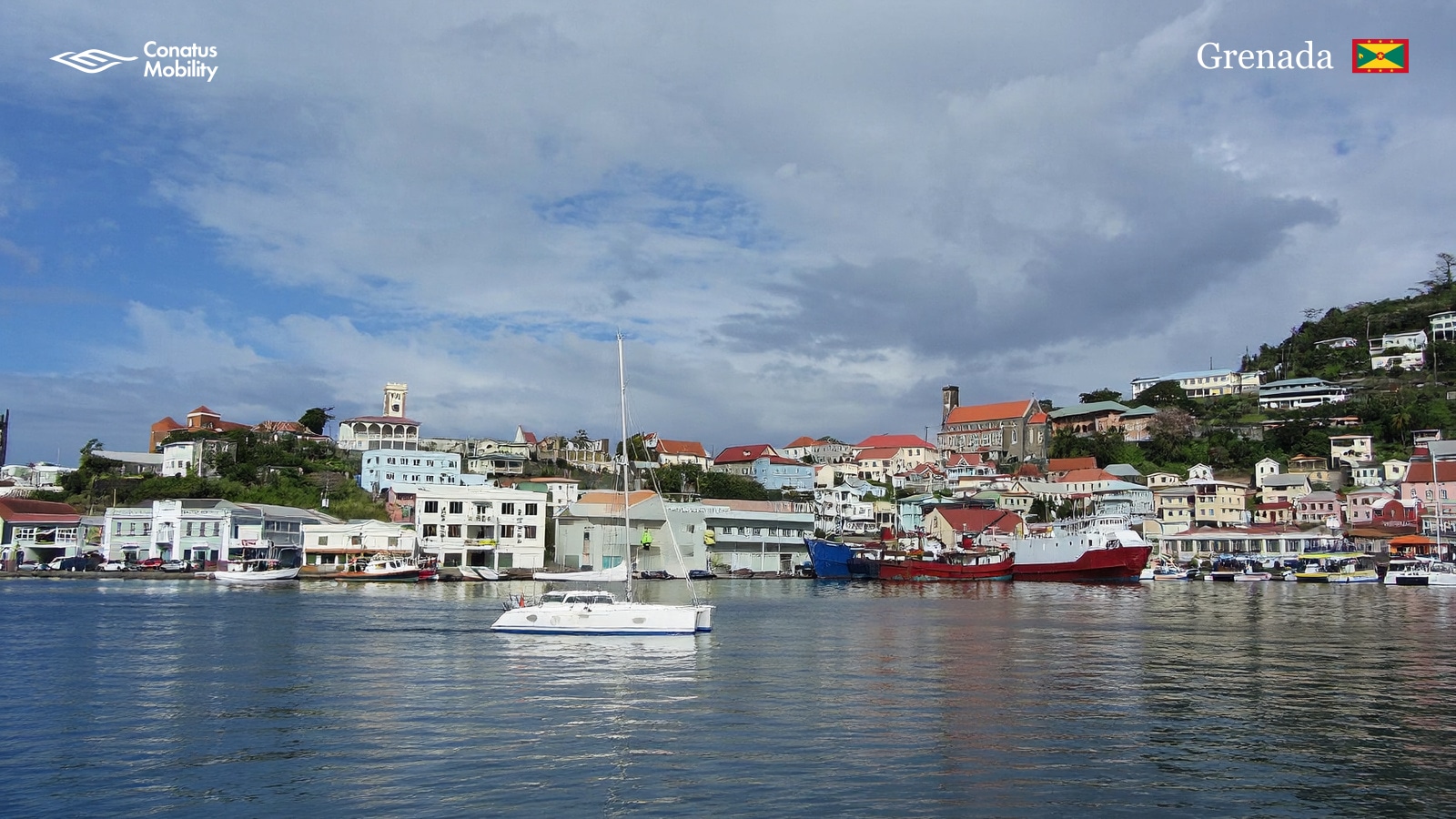
Grenada lies in the south-eastern Caribbean between Trinidad and Tobago and St Vincent and the Grenadines. Its territory covers about 344 square kilometres, including Grenada, Carriacou and Petite Martinique. The capital, St George’s, is on the main island’s south-west coast, where government offices, the port and commercial services are concentrated. The northern islands rely on sea links to the capital and their neighbours. Communities on opposite sides of a national boundary retain longstanding fishing, trading and family ties.[13][17]
The preliminary 2021 census recorded 109,021 residents. St George parish, the most populous, extends beyond the capital itself. Grenada became independent from Britain on 7 February 1974 and has a parliamentary system, with English as the language of administration and application forms. Day-to-day spending is generally in Eastern Caribbean dollars (XCD). The currency union maintains a fixed rate of USD 1 to XCD 2.70. Local prices may be in XCD even though citizenship contributions and fees are published in US dollars.[1][13][14][18]
A nutmeg appears on the national flag, a reminder of the spice trade that linked inland growers with the ports. Tourism, other services and construction also support employment and government revenue today. After Hurricane Beryl struck the northern islands in July 2024, the Pan American Health Organization cited an estimate that 95% of homes on Carriacou had been affected. That figure describes housing on Carriacou. The World Bank’s country account puts the wider recovery in the context of disaster insurance and emergency financing.[13][15][18][19]
For families considering residence, the distribution of medical care matters. The General Hospital is in St George’s, Princess Alice Hospital is in St Andrew and Princess Royal Hospital serves Carriacou. International students come to St George’s University to study medicine and veterinary medicine. The availability of a university course says little about whether a resident can obtain particular specialist care close to home. For someone needing regular appointments, the relevant questions concern the local clinic, transport to the main island and the effect of bad weather on that journey.[13][16][19]
What a contribution to the fund buys
The National Transformation Fund (NTF) finances economic development and diversification. Under section 10 of the Citizenship by Investment Act, an applicant makes a non-refundable contribution. Form 6 identifies family members, dates of birth, relationships and the amount contributed. Applicants taking an approved project route instead identify the project, interest or unit and purchase price. A donor receives evidence of a qualifying contribution and has no property to sell or investment units to redeem at a future date.[1][2][9]
Under the 2024 amendment, the base contribution is USD 235,000 for the principal applicant and up to 3 eligible dependants. That gives the family a starting figure. A fifth applicant or a relative in a special fee category can change the amount due. Match the family list to the contribution notice, taking account of each person’s relationship and age. [1][2]
A single family budget may include the contribution, government application fees, translations and authentication. The fund’s payment notice establishes how much the family must contribute. Invoices and bank records identify what other services it paid for and who received the money. Keeping the records separately makes it easier to account for each transfer if the bank later asks. [1][2][9]
A July 2025 investigation shows how closely an individual payment can be examined. IMA resumed applications for a property project after finding no direct evidence of unlawful financing by the developer or promoter. Some individual applicants still had to show that they could afford the investment without deposits from outside parties. In an approved case, the applicant was given a deadline to make good the amount from personal funds or face revocation proceedings. The decision concerned property, but the question of who owns the money also matters to a donor.[5][8]
The rules for parents, children and siblings
The USD 235,000 minimum applies to a sole principal applicant or to one with up to 3 dependants in the ordinary category. Each additional ordinary dependant generally adds USD 25,000. Unused places are not transferable. Some relatives carry a separate contribution even in a small household. A parent or grandparent aged 55 or younger who is fully supported by the principal applicant or spouse adds USD 50,000. A qualifying sibling adds USD 75,000.[1][2][3]
A couple with 2 schoolchildren and a fully supported mother aged 52 would contribute USD 285,000. If the children do not apply, the couple and the mother would still contribute USD 285,000. If the original family of 4 is joined instead by an eligible adult sister, the amount rises from USD 235,000 to USD 310,000. These figures cover only the fund. Application, processing and individual checks for the additional member must be accounted for separately.[1][2][3]
The 2019 amendment distinguishes parents over 55 from those aged 55 or younger. Both categories require full support. A parent who has just turned 55 remains in the USD 50,000 category. At 56 the age category changes, but the support requirement remains. Records of regular housing, living or medical expenses can show the arrangement more clearly than the receipt for an occasional holiday gift. Evidence depends on the circumstances. Age alone does not establish eligibility.[2][3]
A child aged 18 or over but under 30 must meet the dependency requirements on the principal applicant or spouse. For a 24-year-old graduate student abroad, the birth record establishes parentage, while enrolment, tuition payments and living expenses help explain the present financial arrangement. An adult sibling must be a biological or adopted sibling of the applicant or spouse, single and childless. A further provision covers a child born within 12 months of citizenship being granted to the principal applicant or spouse. The relevant reference date is the grant of citizenship, regardless of when the family first approached an agent or paid a fee.[3]
What changes a family’s bill
Take a couple filing with children aged 8 and 12, all in the ordinary category. Application fees of USD 1,500 per person total USD 6,000. Processing, at USD 1,500 per adult and USD 500 per child under 17, adds USD 4,000. Each adult incurs USD 5,000 for due diligence and USD 1,000 for the interview. Neither child has reached the fee threshold for those checks. Including the NTF contribution, the subtotal is USD 257,000, before professional fees, passports, medical examinations, translations, certification or delivery.[1][4][12]
For a self-funded individual with no spouse or sponsor requiring separate checks, the same schedule gives USD 235,000 to the fund, USD 1,500 to apply, USD 1,500 for processing, USD 5,000 for due diligence and USD 1,000 for interview. The subtotal is USD 244,000, or USD 13,000 less than the family of 4 above. Their fund contribution is identical. Age-specific checks and processing account for the difference, while professional and document costs need not vary in proportion to headcount.[1][2][4][12]
If one child turns 17 before filing, the family can remain in the same contribution band. The child’s processing fee rises by USD 1,000, with USD 5,000 in due diligence and USD 1,000 for the interview now due. On the same assumptions, the subtotal increases by USD 7,000 to USD 264,000. A non-applying spouse or a relative providing funds may also need identity checks and incur fees. Identifying the applicants, anyone financing them and any non-applying spouse gives a more accurate quotation than a count of passports alone.[1][4][12]
Two official pages present the costs differently. The application page separates USD 5,000 for adult due diligence and USD 1,000 for interview, while the enquiries page gives a USD 6,000 due diligence figure. A written quotation should identify the age and role of each person and say whether the interview is included. Adding the enquiries figure to the itemised charges would double-count costs. The amount payable should reconcile with the instructions issued for the case.[1][4][12]
Personal history and the origin of the money
The principal applicant must be at least 18, meet the programme’s health requirements and have lawful means to make the contribution. International marketing agents can help prepare a file. A licensed local agent submits it and handles correspondence with the authorities. Form 1 distinguishes names at birth, current passport names and former names, requests a continuous 10-year address history and asks about citizenships, residence documents and visas. For families with births, marriages or name changes recorded in different countries, the chronology should match their civil records.[1][11]
Form 1 also asks about children, including biological, adopted and stepchildren. Listing a relative in the family history establishes the relationship for disclosure purposes. Whether they are actually applying is a separate question answered by the applicant list and investment confirmation. In a divorced or blended family, records of birth, custody and present residence may come from different authorities. Where an earlier surname appears, the evidence and timing of the change help identify the same child throughout the file.[9][11]
A refusal of a visa by a country with a visa-free arrangement with Grenada, where the applicant has not subsequently obtained a visa for that country, can be grounds for refusal. If there was an appeal or a later grant, the original decision and its outcome both belong in the history. A replacement passport may leave the visa record in an older document without changing the decision itself. Translations and certification must meet Grenada’s English-language requirements. The applicant remains accountable for statements completed by an agent.[1][11]
Form 5 asks what activity generated the money, which businesses employ the applicant or are under their control, where those businesses operate and which account will fund the payment. For dividends, accounts establish company earnings, the share register records ownership, and the dividend resolution and transfer trace cash to the individual. For a property sale, title and completion records should establish the amount remaining after mortgage repayment. If a spouse or other relative provides the money, the relationship and source of funds should be disclosed as they actually are.[9][10]
Form 5 requests companies in which the applicant beneficially owns an equity interest as well as employment and business particulars. A person can work in one country, own a company registered in another, sell into other markets and bank elsewhere. Recording each of those facts enables the reviewer to connect employment history, ownership and the payment trail. When a holding company sells a subsidiary, the buyer’s payment to the holding company does not become the ultimate shareholder’s personal bank deposit at completion.[10]
Applicants can indicate a preferred interview language. The evidence concerns each person’s own life: a child’s education and residence, for example, or how a business owner acquired shares and who received the sale proceeds. When an individual sells their shares, the buyer may pay that individual directly. When a company sells an asset and subsequently distributes proceeds, the first payee is the company. Different documents will connect the eventual payment to the applicant. The dates, owners and credited amounts should agree before filing.[10][12]
From a favourable decision to registration
The Citizenship by Investment Committee reviews the case and due diligence findings and makes a recommendation to the responsible minister. The outcome may be approval, further processing or refusal. On a successful application, the Committee instructs the applicant through the local agent to make the NTF contribution. Receipts for application, processing or due diligence fees paid earlier do not constitute these instructions. Documents for an asset sale or cross-border payment can be prepared in advance, but the beneficiary, amount and due date must come from the notice for the case.[1][9]
The official procedure directs applicants first to an authorised international marketing agent, who liaises with the authorised local agent. Relatives working or studying in different countries may arrange photographs, certified signatures, medical examinations and police records in different places. The local agent brings the material together. Any request for supplementary evidence should identify the person, period and record concerned. A request to replace one adult relative’s document does not, by itself, amount to approval or a new fee assessment for the entire household.[1][4][11]
After proof of contribution is received, the Committee issues the certificate of registration. The local agent then applies for the passport on the citizen’s behalf. A favourable decision, registration and possession of a usable travel document can all fall on different dates. IMA says there is no paid fast-track service. A household facing a fixed school or employment date needs the registration and passport status for the individual concerned, together with time for delivery.[1][4]
Residence requirements and regional negotiations
On 19 August 2026, IMA addressed the proposed regional residence requirements. Implementation, originally expected on 31 August, depended on the regional regulator becoming operational and on the participating states formally agreeing and communicating a commencement date. A family’s plans for visits and the evidence to retain should follow the provisions applicable to its own filing or grant. The circular supports neither treating the original date as effective nor assuming a permanent exemption from residence.[6]
Eastern Caribbean governments have also discussed the EU’s proposed timetable for phasing out citizenship by investment. Regional statements refer to 1 June 2028. The European request does not itself set a Grenadian filing deadline. A family considering an irrevocable contribution can establish its dependants’ eligibility, the payments involved and the domestic application procedure. Future entry conditions remain a matter for each destination and depend on the documents, visas or residence rights each traveller then holds.[1][2][7]
Sources
- Investment Migration Agency Grenada (IMA), application process and fee schedule
- IMA, 2024 threshold circular and attached Amendment (No. 2) Regulations, SRO 15
- Parliament of Grenada, Citizenship by Investment (Amendment) Act No. 3 of 2019, section 2
- IMA, questions on fees, agents and processing
- IMA, Circular 2 of 2025 on discounting and financing
- IMA, Circular 2 of 2026 on commencement of residence requirements
- Government of Antigua and Barbuda, regional consultations on the EU position
- IMA, Circular 9 of 2025 on the outcome of an investigation
- IMA, Form 6, Investment Confirmation
- IMA, Form 5, Employment Status, Wealth and Business
- IMA, Form 1, Personal Information
- IMA, circular on interviews and identity checks
- Government of Grenada, country profile and history
- CARICOM Statistics, preliminary results of Grenada’s 2021 census
- World Bank, Grenada country overview
- Government of Grenada, public infrastructure and hospital locations
- UNESCO, Grenada’s submission on the Grenadines
- Ministry of Finance, Government of Grenada prospectus 2022
- Pan American Health Organization, Natural Hazards Monitoring, 12 July 2024